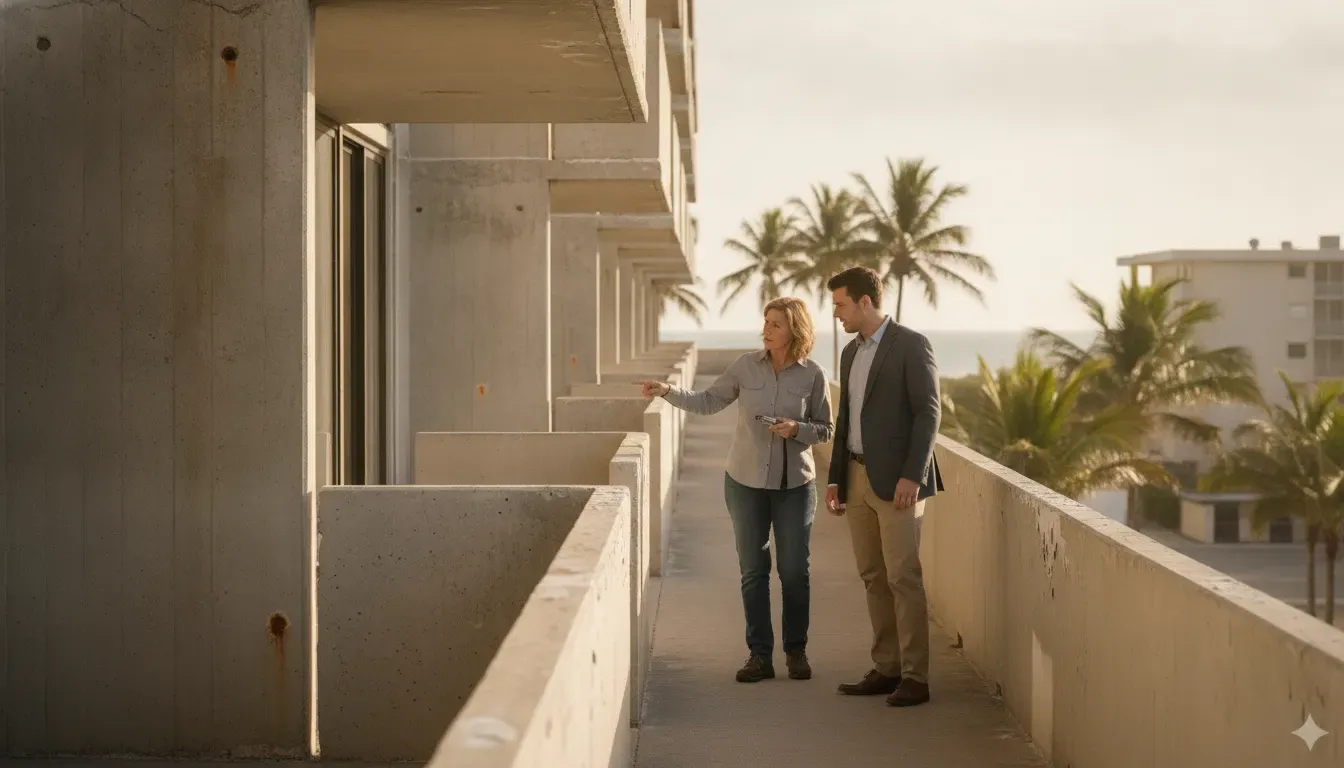
If your Florida building is approaching its 50-year mark, start planning before a notice or failed inspection creates a deadline problem. A 50-year building recertification is not one identical statewide event. The required inspection, report, and repair process depends on the building type and the local enforcement agency.
Need help coordinating a Florida building recertification? Contact Violation Clinic.
What does 50-year building recertification mean in Florida?
A 50-year building recertification is usually an age-related safety review for an older commercial, multifamily, or other qualifying building. It may involve structural and electrical evaluations, sealed reports, local filing, and repairs. In some jurisdictions, the 50-year review is a recurring cycle after an earlier 30-year or 40-year review, not a separate statewide program.
The phrase is commonly used by owners, associations, engineers, and local building departments to describe the next major recertification milestone. It should not be treated as proof that every Florida building has the same deadline or inspection scope.
Is there a statewide 50-year recertification deadline?
No single Florida rule gives every building a universal 50-year recertification deadline. Florida Statutes Section 553.899 establishes a milestone inspection program for qualifying condominium and cooperative buildings that are three habitable stories or more, with initial timing based on building age and location. Local recertification programs can apply different requirements to other buildings.
How the state milestone program fits in
Under Florida Statutes Section 553.899, a qualifying condominium or cooperative generally has an initial milestone inspection when it reaches 30 years, or 25 years when located within three miles of a coastline, followed by inspections at recurring intervals. The law describes a phase one visual inspection by a licensed architect or engineer. A phase two inspection may be required when phase one identifies substantial structural deterioration.
This state program does not answer every question an owner has about a 50-year recertification. It does not replace local notices, local filing instructions, or a jurisdiction’s rules for commercial and multifamily buildings outside the state program.
Why the local building department matters
Miami-Dade County, for example, describes a building recertification program that begins at 30 years and continues every 10 years for the life of a qualifying structure. Miami Beach publishes its own recertification process for commercial and multifamily buildings. Those examples show why the building’s certificate of occupancy date, location, use, height, and prior filings matter more than the age label alone.
Begin with the notice or portal for the property. The Violation Clinic building recertification service page can also help you organize the next steps, but the local building official remains the authority for the applicable deadline.
What does the review usually cover?
The exact scope varies, but an owner approaching a 50-year building recertification should expect the professional team to examine the building’s structural condition, electrical safety, prior repair history, and documents needed for a defensible report. The goal is to identify conditions that affect safe continued occupancy and determine what must be corrected.
Structural review
A structural professional may review major structural components and visible conditions such as:
- Foundations, columns, beams, load-bearing walls, slabs, and roof systems
- Balconies, walkways, parking structures, stairs, railings, and exterior elements
- Concrete deterioration, corrosion, water intrusion, movement, or damaged connections
- Signs that a crack, sag, leak, or surface defect may indicate a deeper structural condition
- Previous engineering reports, repair records, permits, and unresolved violation notices
A surface crack is not automatically a substantial structural defect. The licensed professional must evaluate whether the observed condition affects structural integrity or signals a dangerous condition.
Electrical review
Where the local program requires an electrical recertification, a qualified electrical professional may review the service, distribution equipment, wiring, grounding, panels, and other safety-related components. The team may also compare field conditions with available permit and alteration records.
Owners should not assume that a building passing a prior inspection will pass the next one unchanged. Moisture exposure, renovations, deferred maintenance, unauthorized alterations, and aging equipment can create new issues.
Documents and site conditions
The review is more efficient when the professional can see the building’s history and access the areas identified by the local requirements. Missing records do not automatically end the process, but they can make it harder to confirm what was approved, repaired, or previously reported.
Owner checklist for the 6 to 12 months before the deadline
The best way to manage a 50-year building recertification is to treat it as a coordination project, not a single inspection appointment. Start early enough to confirm the rule, hire the right professionals, gather records, reserve access, and leave time for repairs and reinspection if the report identifies deficiencies.
- Confirm the jurisdiction and building classification. Identify the city or county enforcement agency, building use, number of stories, certificate of occupancy date, and whether the property is a condominium, cooperative, commercial building, or another type.
- Find the official deadline or notice. Check the local building department portal, mailed notice, or written instruction. Save the notice and record any report-submission deadline, extension procedure, fee, and required forms.
- Hire qualified professionals. Confirm that the architect or engineer is licensed in Florida and qualified for the structural or electrical scope required by the jurisdiction. Ask whether one coordinated team can manage both disciplines.
- Assemble the building file. Gather the certificate of occupancy, prior recertification reports, permits, approved plans, repair invoices, violation notices, maintenance records, insurance inspection reports, and records of alterations.
- Walk the property before the formal inspection. Note leaks, corrosion, spalling, exposed reinforcement, damaged railings, electrical concerns, blocked access, and areas that require keys, escorts, shutdowns, or advance notice.
- Reserve time for corrections. Build a schedule for proposals, permits, contractor work, inspections, report revisions, and final submission. Do not plan around the first available inspection date alone.
- Track every deliverable. Keep a written log of the inspection date, report status, correction list, permit numbers, reinspection dates, filing confirmation, and any communication with the enforcement agency.
For a related explanation of how to use engineering findings, review how to read a building structural inspection report. That information can help an owner understand the difference between an observation, a recommended repair, and a condition that requires immediate coordination.
What records should owners gather?
Start with records that establish the property’s identity, age, prior approvals, and repair history. A complete file helps the inspection team verify changes and helps the owner respond quickly if the local agency requests clarification.
- Certificate of occupancy, original construction information, and property identification
- Prior 30-year, 40-year, milestone, structural, or electrical inspection reports
- Open and closed permits, plans, inspection cards, certificates of completion, and permit closure records
- Repair contracts, invoices, photographs, warranties, and engineering letters
- Code enforcement, unsafe structure, fire, or building violation notices
- Records of renovations, additions, enclosed balconies, roof work, electrical work, or other alterations
- Maintenance records for waterproofing, concrete repairs, balconies, parking areas, electrical equipment, and life-safety systems
If a previous owner performed work without completing the permit process, disclose that history to the professional team. Concealing an alteration can create a larger compliance problem when the field condition does not match the available records.
How should owners handle deficiencies?
When a report identifies a deficiency, separate the technical finding from the administrative steps needed to close it. The professional should explain the condition and recommended correction. The owner, association, contractor, and local agency then need a documented path for permits, repairs, reinspection, and final acceptance.
- Prioritize safety. Address dangerous conditions, unsafe access, water intrusion, exposed structural elements, or electrical hazards before cosmetic work.
- Clarify the correction. Ask for the affected component, required repair, responsible professional, and evidence needed to verify completion.
- Check permit requirements. Do not assume repair work can begin without permits. Miami-Dade’s official recertification guidance states that required repairs should be properly permitted before recertification.
- Coordinate the disciplines. A structural repair can affect electrical systems, waterproofing, fire safety, or occupancy. Keep the architect, engineers, contractor, and property manager aligned.
- Document the work. Keep permits, inspection approvals, photographs, invoices, sealed letters, and final reports together.
- Confirm written closure. A completed repair is not the same as a closed recertification case. Obtain the local filing or approval confirmation required for the property.
Violation Clinic helps property stakeholders coordinate code violation and building compliance issues, including documentation and permit-closure challenges. See the broader Violation Clinic services page for the types of remediation support available.
What mistakes create the most schedule risk?
Most delays come from starting with the inspection date instead of the full compliance timeline. Owners can reduce risk by confirming local rules early, gathering records before the professional arrives, and assuming that deficiencies may require permits, contractors, and another review.
- Waiting for a notice before checking the building’s age and prior cycle
- Assuming a 50-year deadline is identical in every Florida city or county
- Hiring a professional who is not qualified for every required discipline
- Leaving roof areas, balconies, mechanical rooms, electrical rooms, or parking areas inaccessible
- Starting repairs without confirming permit and inspection requirements
- Submitting an unsigned, unsealed, incomplete, or outdated report
- Treating a repair invoice as proof that the local agency accepted the correction
Owners comparing milestones should also distinguish a 50-year planning guide from a 30-year inspection guide. The Florida 30-year building recertification guide addresses the initial milestone context. This article focuses on preparing for a later cycle, coordinating remediation, and avoiding last-minute gaps.
50-year building recertification FAQs
Is a 50-year building recertification required for every Florida building?
No. The requirement depends on the building type, jurisdiction, occupancy, height, construction or occupancy records, and applicable local program. Some qualifying condominium and cooperative buildings are also subject to Florida’s milestone inspection law. Confirm the property’s obligation with the local enforcement agency.
Does Florida law create one 50-year deadline?
No. Florida Statutes Section 553.899 establishes a milestone inspection framework for certain condominium and cooperative buildings, but it does not create one universal 50-year deadline for every building. Local recertification programs may use different age milestones, forms, notices, and filing procedures.
Will the inspection include both structural and electrical systems?
Often, local recertification programs require structural and electrical review, but the required scope can differ. Miami-Dade and Miami Beach describe structural and electrical recertification requirements. Ask the local building department and the selected Florida-licensed professionals to confirm which disciplines apply.
What happens if the inspection finds a deficiency?
The owner may need a repair plan, permits, qualified contractors, follow-up inspections, revised professional documentation, and final filing with the local agency. The inspection professional should identify the condition and recommended correction. The owner should track the administrative closure as carefully as the physical repair.
How early should owners start?
Six to 12 months before the expected deadline is a practical planning window for many older buildings, especially when records are incomplete or repairs may be needed. The correct start date depends on the local notice and complexity of the property. Start sooner when access, permits, or major repairs are likely to take time.
Where can I confirm the applicable local requirements?
Start with the building department serving the property. For reference, the Miami-Dade recertification program, Miami Beach building recertification page, and City of Miami recertification guidance illustrate how local procedures can differ. Use the jurisdiction’s current instructions for the final answer.