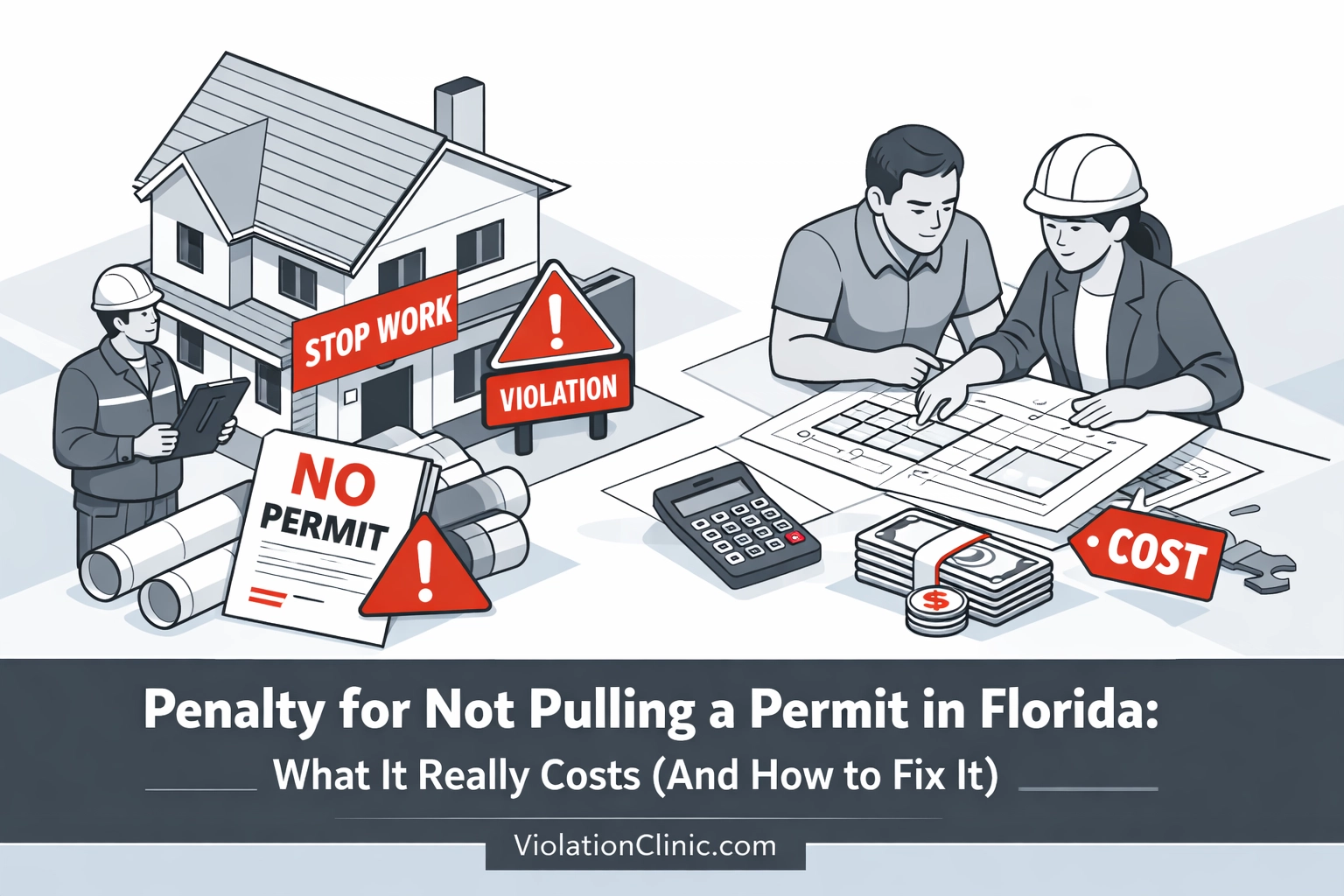
If you've started work without a building permit in Florida: or you bought a property with unpermitted improvements: you're facing consequences that go far beyond a simple fine. The penalty for not pulling a permit in Florida includes daily accumulating fees, forced demolition of completed work, legal trouble, and property value drops that can reach tens of thousands of dollars.
Here's what every property owner, contractor, and real estate professional needs to know about unpermitted work penalties in Florida, how much it really costs to fix, and what steps you must take to resolve violations before they spiral out of control.
The Financial Hit: What You'll Actually Pay
Florida doesn't mess around with permit violations. The state operates on a three-tier penalty structure designed to punish both negligence and intentional evasion:
Base violation fees: Your local building department can issue fines up to $5,000 for the initial violation of working without a permit.
Daily penalties: Once you're cited, you'll pay $250 per day until you achieve full compliance. For willful or repeat violations, that jumps to $5,000 per day. If your project takes 60 days to remediate, you're looking at $15,000 in penalties alone: before you even address the actual work.
Retroactive permit fees: When you apply for a permit after-the-fact, expect to pay double or triple the original permit cost. A $500 permit becomes a $1,500 penalty fee. This is in addition to the regular permit application requirements.
Real-world examples paint a clear picture:
- Unpermitted roof replacement: $8,200+ in combined fines and retroactive fees
- Structural modifications (walls, load-bearing changes): $15,000+
- Storage shed or accessory structure: $1,500+
- Seawall repairs: $12,000+
- Pool installation: One Palm Beach County homeowner faced $78,000 in project delays and remediation costs
These numbers assume relatively quick resolution. If you ignore the violation or contest it through lengthy legal proceedings, costs multiply rapidly.
Beyond Money: The Hidden Consequences
The financial penalties are just the beginning. When code enforcement or your building department discovers unpermitted work, several things happen immediately:
Stop Work Orders Hit Fast
A stop work order Florida building officials issue means exactly what it says: all construction activity ceases immediately. You cannot continue work, occupy the space, or use any completed improvements until you achieve full compliance. This creates cascading problems:
- Construction crews sit idle while you're still paying them
- Material deliveries pile up unused
- Project timelines extend for months
- Holding costs accumulate if the property is under renovation
You May Have to Tear It All Down
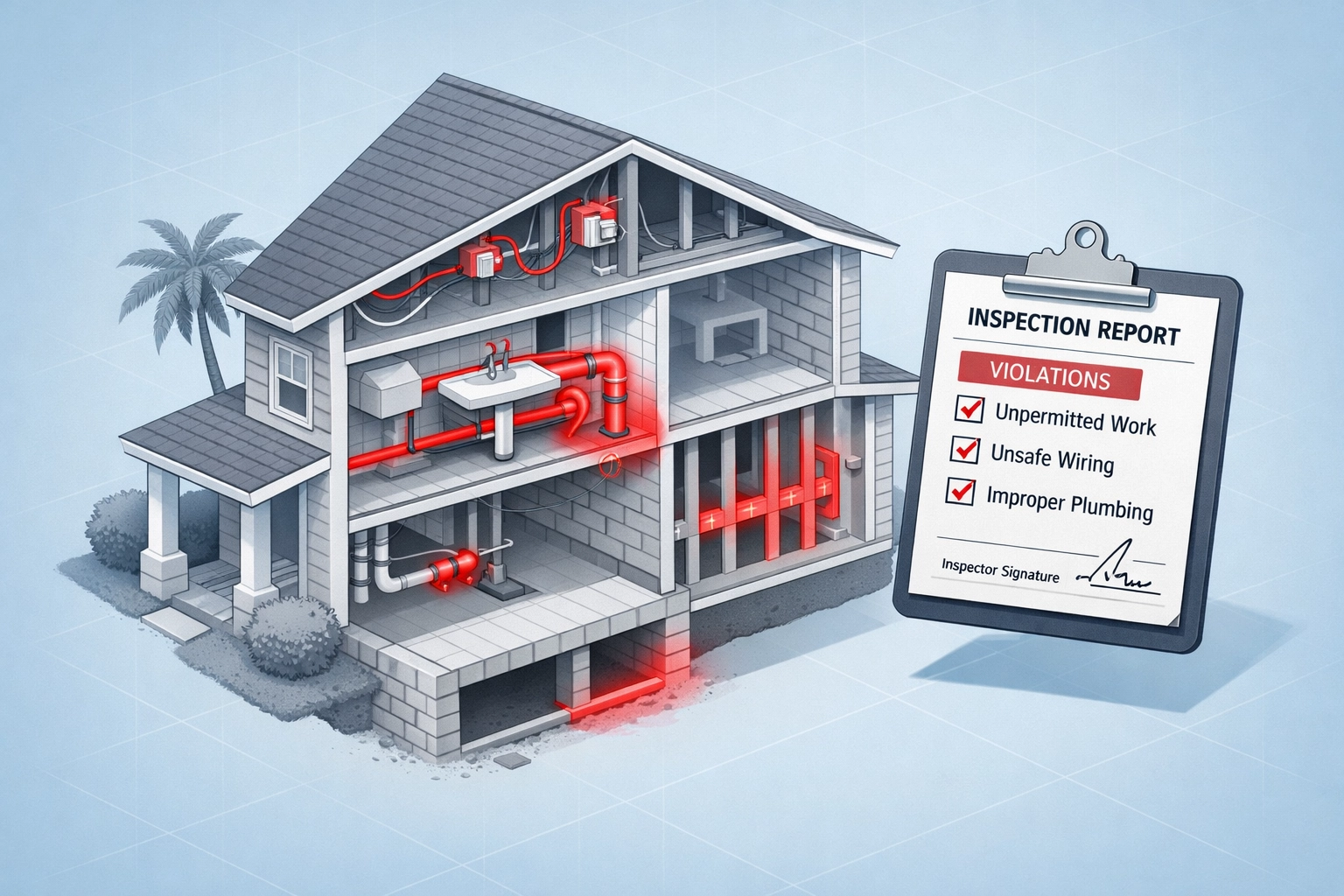
Here's where it gets painful. If structural, electrical, or plumbing work has been concealed behind drywall, flooring, or finished surfaces, building officials will require you to expose the work for inspection. This means:
- Demolishing recently completed walls, ceilings, and floors
- Paying contractors to tear out their own work
- Reconstructing everything after inspection: even if the work was done correctly
One Miami homeowner spent $23,000 removing and replacing finished drywall to expose electrical work that ultimately passed inspection. The work itself was fine: but it was done without permits.
Professional Engineering Reviews
Your building official may demand that a Florida-licensed structural engineer or architect review your project, provide sealed drawings, and certify compliance with the current Florida Building Code. These professional services cost $3,000-$10,000+ depending on project complexity.
For simple projects like deck additions, this requirement can make remediation more expensive than the original construction.
Property Value Takes a Hit
Real estate agents and appraisers consistently report that properties with unresolved code violations sell for 12-18% less than comparable homes with clean compliance records. If you're selling a $400,000 home, that's a potential $48,000-$72,000 reduction in value.
Unpaid fines and violations also trigger property liens, which must be satisfied before you can transfer title. Miami-Dade County adds a 15% administrative fee on top of the original fine amount when recording liens.
Criminal Charges for Serious Violations
Florida Statute 553.84 makes willful permit violations a second-degree misdemeanor, punishable by up to 60 days in jail and a $500 fine. While rare for first-time homeowner offenses, this becomes a real threat if:
- You've received multiple violations
- You've been issued a stop work order and continued working
- The work created dangerous conditions (unsafe structure notice territory)
Unlicensed contractors face even steeper consequences: up to $10,000 in fines plus investigative costs and potential loss of licensure for licensed contractors who knowingly worked without permits.

How to Fix Unpermitted Work in Florida
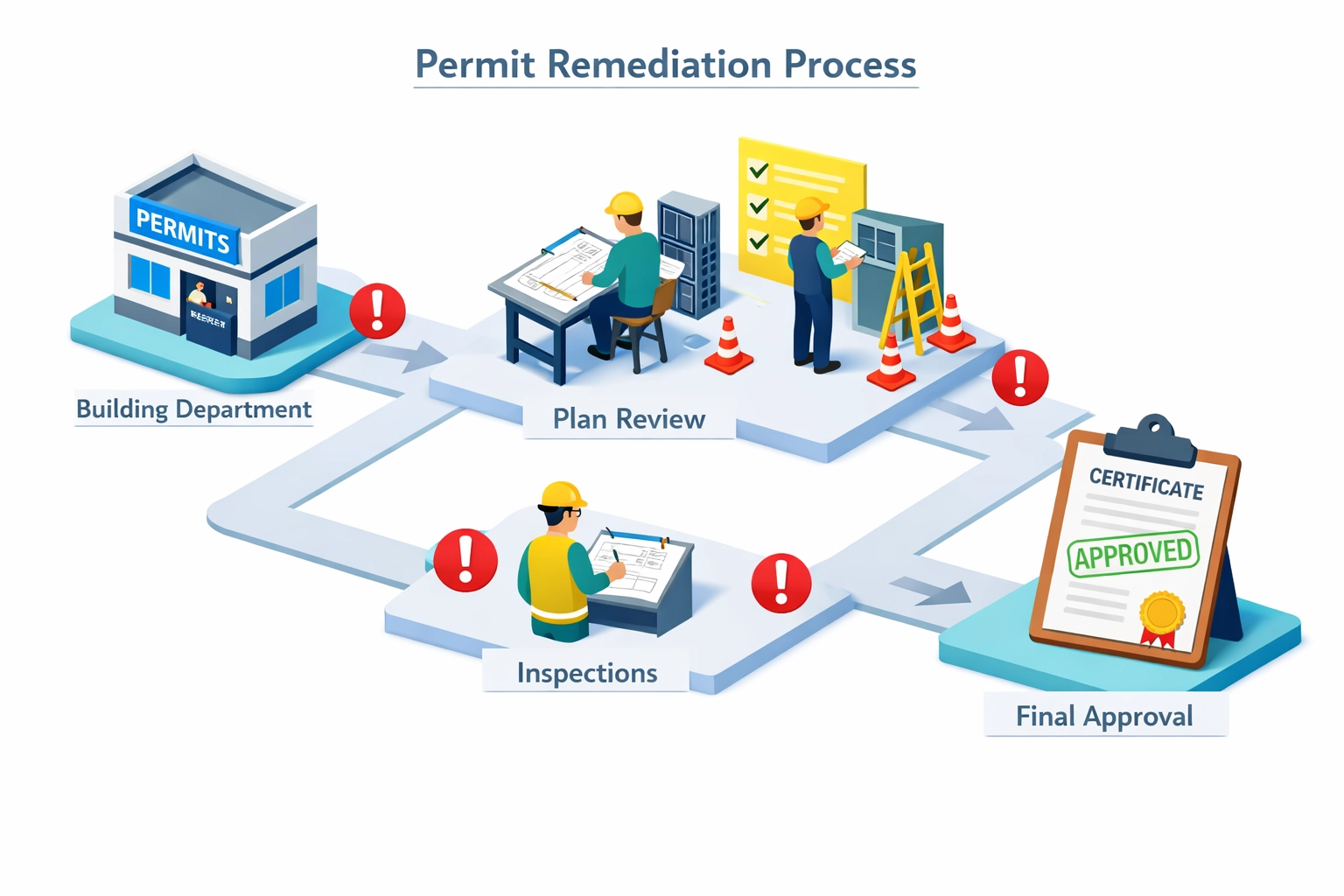
If you're dealing with unpermitted work, immediate action reduces both penalties and stress. Here's your step-by-step remediation process:
1. Contact Your Local Building Department Immediately
Don't wait for code enforcement to find you. Proactive disclosure often results in more lenient treatment. Your building department will:
- Assess what work was completed without permits
- Determine which inspections are required
- Calculate retroactive permit fees
- Provide a timeline for compliance
Ask specifically about their "after-the-fact permit" process: most Florida jurisdictions have standardized procedures for this situation.
2. Hire Licensed Professionals
For any work involving structural, electrical, plumbing, or mechanical systems, you'll need:
- A Florida-licensed contractor in the relevant trade to evaluate and certify the work
- An engineer or architect if required by your building official
- Documentation that all work meets current code requirements (not the code in effect when work was completed: the current one)
Trying to navigate this yourself almost always extends timelines and increases costs.
3. Submit Complete Documentation
Your after-the-fact permit application must include:
- Detailed plans showing what was constructed
- Engineer or architect stamps if required
- Photographs documenting existing conditions
- Contractor certifications for completed work
- Payment of the double or triple permit fee
Incomplete applications get rejected, resetting your timeline and allowing daily penalties to continue accumulating.
4. Schedule and Pass All Required Inspections
This is where exposed work requirements come into play. Your inspector needs to verify:
- Foundation and structural elements
- Electrical rough-in and final connections
- Plumbing rough-in and final connections
- HVAC installation and connections
- Building envelope and energy code compliance
If work is already concealed, selective demolition may be required. Your contractor and inspector can sometimes negotiate limited exposure points rather than complete demolition: but this is at the inspector's discretion.
5. Obtain Certificate of Completion or Occupancy
Once all inspections pass and fees are paid, the building department issues final approval. For residential work, this is typically a certificate of completion. For new structures or substantial renovations, you'll receive a certificate of occupancy.
This documentation is critical for future property sales, refinancing, and insurance claims.
Special Considerations for Florida Property Owners
Florida's regulatory environment includes several unique factors that affect unpermitted work penalties:
Homestead exemptions: Properties with homestead exemptions face additional scrutiny. Unpermitted work that changes square footage or property use can affect your exemption status and property tax assessment.
Hurricane compliance: The Florida Building Code 2025 includes stringent wind resistance and impact protection requirements. Unpermitted work that doesn't meet these standards creates serious liability during storm events: and insurance companies will deny claims for damage to unpermitted structures.
Owner-builder limitations: If you pulled permits as an owner-builder, selling or leasing the property within one year of completion triggers violations for unlicensed contracting. This catches many house-flippers by surprise.
Expired permits: An expired building permit Florida building departments consider abandoned requires reapplication and may trigger inspection of all previously approved work, not just the work that remained incomplete.
Red-tagged structures: A red tagged building designation means the structure is unsafe for occupancy. This is the most serious classification and requires immediate action: often including temporary relocation of occupants while remediation occurs.
Prevention: What Actually Requires a Permit in Florida
The best way to avoid penalties is understanding when permits are required. In Florida, you need permits for:
- Any structural modifications (walls, beams, foundations)
- All electrical work beyond simple fixture replacement
- Plumbing work including fixture installation and re-routing
- HVAC equipment installation or ductwork modification
- Roofing (including re-roofing over existing materials in most jurisdictions)
- Water heaters and gas appliances
- Windows and doors in some jurisdictions (especially impact-rated replacements)
- Fences over certain heights (varies by municipality)
- Pools, spas, and pool enclosures
- Sheds and accessory structures over specified square footage
County and municipal requirements vary. Miami-Dade has more stringent requirements than many rural counties. Always verify with your local building department before starting work.
What Happens If You Ignore Code Enforcement
If you're wondering what happens if you ignore code enforcement notices, the answer is escalation at every stage:
- First notice: Initial violation letter with correction deadline
- Second notice: Increased fines begin accumulating
- Third notice: Stop work order and potential red-tagging
- Legal action: Code enforcement board hearing, court orders, property liens
- Final enforcement: Forced demolition at property owner's expense, criminal charges
One Broward County property owner ignored notices for eight months. The final penalty package exceeded $94,000, required complete demolition of an unpermitted addition, and resulted in a property lien that prevented refinancing.
Get Compliant Before It Gets Worse
Unpermitted work doesn't age out or disappear. It shows up during property sales, insurance claims, refinancing, and when neighbors report to code enforcement. The longer violations remain unresolved, the more expensive remediation becomes.
Compliance fees and violation fines multiply quickly, but working with compliance specialists who understand Florida's building code requirements can reduce penalties by 40% or more through proper documentation and mitigation strategies.
At Violation Clinic, we help Florida property owners and contractors navigate the after-the-fact permit process, code enforcement violations, and building department remediation requirements. Our team works directly with building officials statewide to resolve permit violations, expired permits, and compliance issues efficiently.
If you're facing permit penalties or have discovered unpermitted work on your property, taking immediate action protects your investment and stops the financial bleeding. Understanding your jurisdiction's specific requirements and working with licensed professionals creates the fastest path to resolution: and helps you avoid the six-figure disasters that come from continued delay.