
A failed sprinkler inspection is not a routine maintenance reminder. For a commercial property owner, it can start an enforcement timeline involving reinspection fees, escalating fines, insurance complications, and restrictions on building operations. In serious cases, suppression-system deficiencies can contribute to an unsafe-structure proceeding or stop-work order. This article focuses on sprinkler and fire suppression systems, not the broader category of Florida fire code violations.
Call (786) 885-2613 or contact Violation Clinic for a free case review of your fire suppression violation.
A fire suppression violation florida case usually involves a failed inspection or a documented deficiency that leaves a commercial system out of compliance. The owner must identify the cited condition, coordinate qualified correction, document the work, and pursue reinspection or formal close-out.
The first step is understanding what inspectors routinely flag, from expired records and missing internal assessments to inaccessible control valves, corrosion, and damaged heads. Those details determine how quickly the violation can be corrected and what documentation the property needs next.
Common Fire Suppression Violations in Florida Commercial Properties
Inspectors often find fire suppression deficiencies in the equipment itself, in maintenance records, or in the building changes around the system. These issues can prevent a commercial property from passing inspection and may contribute to unsafe structure proceedings or a stop-work order. Review the broader requirements for fire code violations in Florida, but keep the sprinkler and suppression system details below separate from general fire code issues.
Sprinkler heads and system access
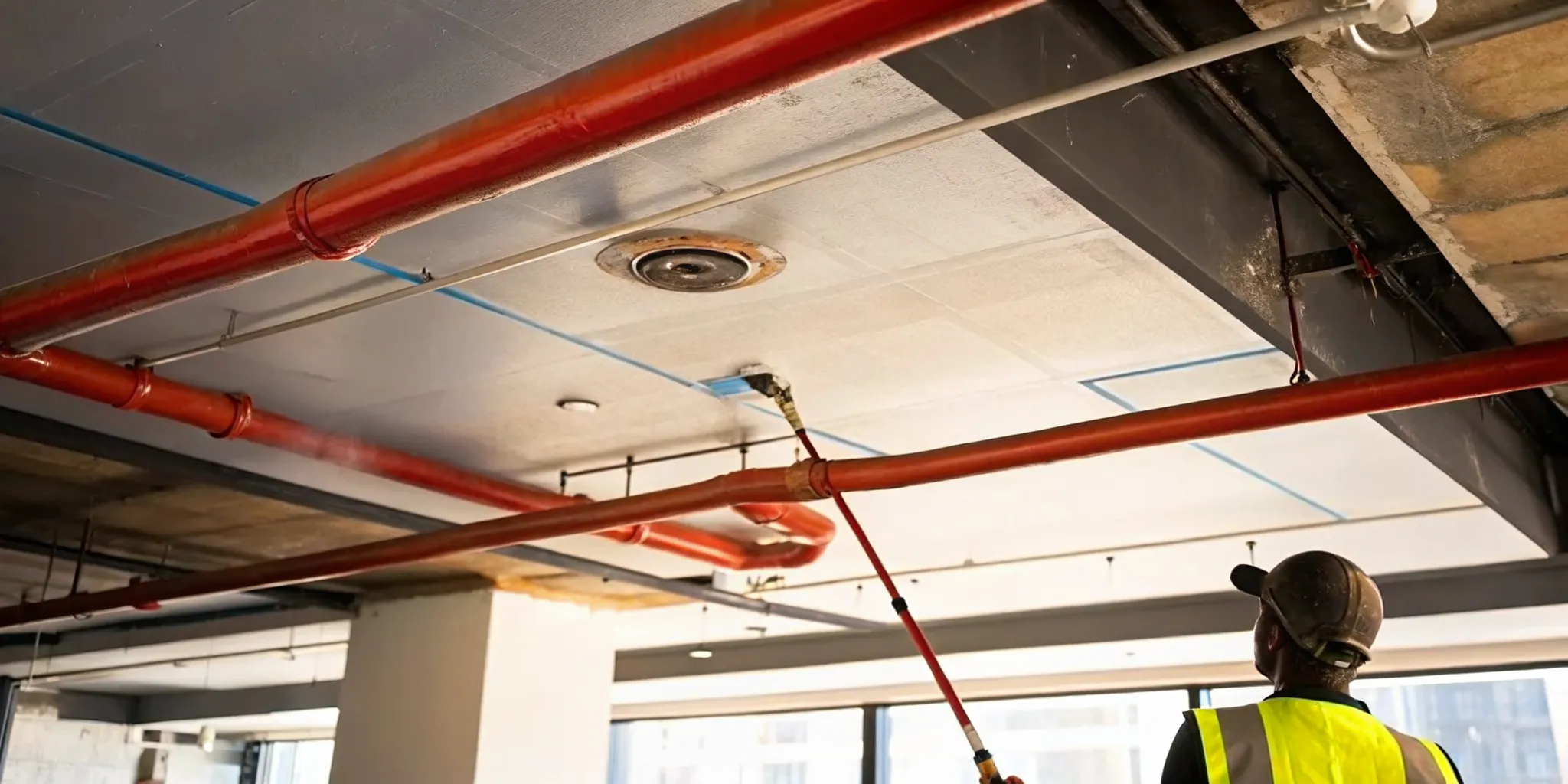
Sprinkler heads must remain visible, unobstructed, and capable of operating as designed. Painted heads, damaged heads, storage that blocks discharge patterns, and construction materials installed too close to sprinklers are common deficiencies. A control valve can also fail inspection. Common reasons include the wrong position, missing security, or storage and equipment blocking access.
Inspection records and required assessments
Missing or expired NFPA 25 inspection tags are a frequent problem in Miami-Dade and Broward commercial buildings. The system should have current documentation showing that required inspection, testing, and maintenance work was completed. NFPA 25 requires annual sprinkler inspections, along with more frequent daily, weekly, monthly, quarterly, or semi-annual tests when the standard calls for them. Florida rules also require a durable record tag on the system’s main water control valve after inspection and testing. Florida’s adopted fire protection rules incorporate these inspection and recordkeeping obligations.
Another deficiency is a missing five-year internal assessment. This assessment can identify internal obstruction, deterioration, or other conditions that an exterior visual check will not reveal. An expired tag or missing assessment is not merely an administrative oversight. It can show that the required inspection cycle was not completed or cannot be documented.
Corrosion, leaks, and coverage gaps
Corrosion and leaks at fittings, pipes, and risers deserve prompt attention. They are especially common in coastal and high-humidity areas, including parts of Miami-Dade and Broward. A renovation can create a different problem if walls, ceilings, partitions, storage areas, or new layouts leave portions of the building without adequate sprinkler coverage. The suppression design must still protect the occupied areas after the work is complete.
Inspectors may also request current fire alarm certifications or identify missing certification records where the alarm and suppression systems are coordinated. Do not assume an older building is exempt. NFPA 25 applies to the required inspection, testing, and maintenance of covered systems regardless of the building’s age or when the system was installed. The practical response is to identify each cited deficiency, restore access and operation, obtain the required licensed inspection work, and document the correction for reinspection.
| Deficiency | What inspectors look for |
|---|---|
| Obstructed or painted sprinkler heads | Heads must be visible, unobstructed, and free of paint or damage so discharge patterns work as designed. |
| Expired or missing inspection tags | Current NFPA 25 documentation, plus a durable record tag on the main water control valve. |
| Missing five-year internal assessment | Evidence of internal obstruction or deterioration that a visual check cannot reveal. |
| Control valve access or position | Valves in the correct position, secured, and reachable without moving storage or equipment. |
| Corrosion or leaks | Fittings, pipes, and risers checked for corrosion and leakage, especially in coastal and high-humidity counties. |
| Coverage gaps after renovations | Walls, ceilings, and new layouts must not leave occupied areas without sprinkler protection. |
Which Rules Govern Fire Suppression Systems in Florida
Florida fire suppression compliance is governed by a layered framework, not by a single inspection checklist. The Florida Fire Prevention Code (FFPC) adopts nationally recognized fire protection standards, including NFPA 25, the Standard for the Inspection, Testing, and Maintenance of Water-Based Fire Protection Systems. For a commercial property owner, that means sprinkler systems must be inspected, tested, and maintained according to the applicable NFPA requirements as adopted in Florida.
The Florida Fire Prevention Code and NFPA 25
NFPA 25 addresses the ongoing condition of water-based suppression systems. Its requirements cover inspection and testing schedules, maintenance, records, and the correction of deficiencies. Florida’s rules also require the more frequent inspections or tests specified by NFPA 25 when an annual inspection or test applies. A missed inspection is therefore not simply an administrative oversight. It can leave the property out of compliance with the adopted fire code.
Florida’s State Fire Marshal adopts the FFPC on a three-year cycle under Chapter 633.202, Florida Statutes. The current 8th Edition (2023) became effective December 31, 2023. When a property receives a fire suppression violation, the applicable edition, local enforcement language, inspection records, and system condition all matter. Do not assume that an older building is exempt from current inspection and maintenance obligations.
Chapter 633 and contractor requirements
Chapter 633, Florida Statutes, establishes statewide fire safety standards intended to protect public health, safety, and welfare. Florida Administrative Code Rule 69A-46.041 requires a Fire Protection Contractor performing inspection, testing, or maintenance to comply with Chapter 633 and the applicable NFPA 25 standards. This is why system work should be handled by the properly licensed and permitted professionals required for the service. Owners should not rely on improvised or unqualified maintenance work.
Florida also requires a durable, weather-resistant record tag on the main water control valve. A Fire Protection Contractor or permitted water-based fire protection inspector places the tag after inspection, testing, or maintenance. The tag is part of the system’s compliance record and should match the work actually completed. Missing or outdated documentation can create an additional problem during enforcement review or reinspection. When a fire suppression violation notice is issued, review the cited deficiency, the inspection history, and the required close-out evidence together. That establishes which rule applies and what must be corrected before requesting final approval.
Read Florida Administrative Code Rule 69A-46.041 for the contractor, inspection, testing, maintenance, and record-tag requirements.
What Happens After a Fire Suppression Violation in Florida
A failed inspection starts an enforcement timeline, not a routine maintenance reminder. The authority having jurisdiction documents the life-safety deficiency and may issue a notice, correction order, or other direction requiring the property owner to address the system problem. The exact process varies by jurisdiction, but ignoring the first notice usually makes the next inspection more expensive and more disruptive.
Reinspection fees and escalating property consequences
Once a suppression system fails inspection, the owner may face reinspection fees and escalating fines while the deficiency remains open. The issue can also complicate insurance underwriting or renewals, delay related permit work, and create occupancy restrictions that affect tenants or business operations. A property that cannot demonstrate a compliant, documented fire protection system may also face additional scrutiny during a sale, refinance, or lease transaction.
These consequences are not limited to the sprinkler head or valve identified in the report. A correction order can require records, testing, access, repairs, or other evidence that the system is being maintained as required. Florida rules incorporate NFPA 25 inspection, testing, and maintenance requirements, including the frequencies that apply to the system. After inspection or testing, the main water control valve must also carry a durable record tag showing that the required work occurred. Florida’s fire protection system rules establish these documentation requirements.
When enforcement affects occupancy or construction
Serious or unresolved conditions can move beyond fees. A jurisdiction may restrict occupancy, issue a stop-work order, or begin an unsafe structure proceeding when the condition creates a significant life-safety concern. Fire suppression and sprinkler violations can contribute to those actions. That is especially true when a system is inoperative, access is blocked, or required repairs are not completed. The resulting closure or work stoppage can quickly magnify tenant, scheduling, and carrying costs. other Florida fire code citations may also create broader property compliance issues that must be resolved alongside the suppression deficiency.
Florida law includes misdemeanor exposure
Florida Statutes section 633.124 makes violating a fire safety law, a State Fire Marshal order, or a corrective order a second-degree misdemeanor. The statute treats intentionally or willfully rendering a required fire protection system inoperative as a first-degree misdemeanor. That means an owner or responsible party should not disable, bypass, or leave a required system out of service while waiting for a cheaper or more convenient solution. Review the statutory fire safety penalties with qualified counsel when the facts may involve willful conduct.
Enforcement can also reach the licensed contractor. Under section 633.316, the State Fire Marshal may suspend a qualifying fire suppression contractor license for up to two years. Revocation is available for up to five years for statutory noncompliance or failure to follow a notice or corrective order. Owners should verify that corrective work is performed and documented by an appropriately licensed professional, then submit complete evidence for reinspection and close-out.
How to Fix a Fire Suppression Violation in Florida
A fire suppression violation should be handled as a documented close-out process, not a quick equipment patch. Use this sequence to address the cited deficiency, give the authority having jurisdiction a complete record, and keep the system in compliance after the case is closed.
- Review the notice line by line. Identify every deficiency, the affected system component, the corrective language, and the deadline or reinspection condition. Compare the notice with the latest inspection report. Common deficiencies include missing or expired NFPA 25 records, missing five-year internal assessments, painted or damaged sprinkler heads, and inaccessible or incorrectly positioned control valves. Corrosion and leaks at fittings and risers are also common, and inspectors cite many of these issues in Miami-Dade and Broward. Do not assume the notice is limited to one visible defect.
- Hire a licensed Fire Protection Contractor. The contractor should inspect, test, and maintain the system, then identify what must be repaired or replaced. Florida rules require Fire Protection Contractors performing this work to comply with Chapter 633, Florida Statutes, and the applicable requirements of NFPA 25. Florida’s fire protection contractor rule also governs inspection, testing, and maintenance responsibilities.
- Correct every cited deficiency. Do not stop after fixing the most obvious item. Address the full list, including damaged heads, valve access, leakage, corrosion, testing failures, and missing inspection work when applicable. NFPA 25 maintenance does not end after the violation is closed. Annual inspections can also require more frequent daily, weekly, monthly, quarterly, or semiannual tests under the standard.
- Build a traceable correction package. Keep contractor reports, test results, invoices, photographs, replacement records, and any five-year assessment. Map each completed correction to the exact language in the original notice. After inspection or maintenance, Florida requires a durable, weather-resistant record tag on the system’s main water control valve. That record tag should be present and legible, not treated as a substitute for the underlying documentation.
- Submit the package and schedule reinspection. Present the correction records to the authority having jurisdiction using its required process. Confirm that the reinspection covers every cited item, then obtain written confirmation of approval or close-out. If the authority identifies a remaining deficiency, return it to the contractor promptly instead of allowing the enforcement timeline to continue.
- Keep the system ready for the next inspection. Store current reports and tags where responsible staff can find them. Track recurring NFPA 25 testing, maintain clear access to control valves, and address leaks, corrosion, or damaged heads as soon as they appear. Close-out is one milestone. Ongoing inspection and maintenance are what keep the next annual review from becoming another violation.

How Violation Clinic Helps Commercial Property Owners Resolve Fire Suppression Violations
A fire suppression violation is not a routine maintenance reminder. It can place a commercial property into an enforcement process involving reinspection, fines, insurance complications, occupancy restrictions, or a stop-work order. Violation Clinic works with owners who are already facing that problem and need the violation resolved, documented, and closed.
Our role is remediation. We do not approach the matter as a general permit-expediting request or a replacement for the licensed fire protection contractor performing inspection, testing, and maintenance. Instead, we coordinate the compliance work around the violation so the technical correction and the municipality’s requirements stay aligned.
Translate the violation into an executable correction plan
Notices and inspection reports can identify a failed condition without giving an owner a practical path to close-out. Violation Clinic reviews the cited language, available inspection records, system documentation, and property history. The team then helps organize the issues into a correction plan that can be handled by the appropriate licensed professionals.
That distinction matters when the problem involves missing NFPA 25 records, an absent five-year internal assessment, a damaged or painted sprinkler head, or an inaccessible control valve. Corrosion and leaks at fittings or risers are also part of the correction file. Florida requirements also call for a durable record tag on the main water control valve after the system has been inspected, tested, or maintained. The correction file should show what was fixed and how each fix answers the cited deficiency.
Manage communication with the building department
Owners and property managers often lose time when contractor documents, municipal notices, and reinspection requests are handled separately. Violation Clinic serves as the procedural partner between the owner, the licensed fire protection contractor, and the building department. The team communicates with the relevant officials, tracks requested materials, and keeps the response focused on the exact language in the enforcement record.
The company draws on licensed professionals, including former municipal building officials, inspectors, and engineers, to navigate complex building department requirements. That experience helps identify what the jurisdiction needs before requesting reinspection, rather than submitting an incomplete package and extending the enforcement cycle. Learn more about Violation Clinic services.
Reduce the financial and transaction risk
Leaving a violation open can expose an owner to continuing fines, property liens, and a transaction that cannot close. Violation Clinic helps keep the remediation moving by coordinating documentation, follow-up, and close-out steps. Owners dealing with broader enforcement balances can also review this guide to resolving code enforcement fines.
The objective is a defensible record of correction and a completed municipal process. Once the licensed technical work is finished, Violation Clinic helps assemble the evidence, address outstanding requests, and drive the property toward reinspection and formal close-out.
Ready to resolve your fire suppression violation? Contact Violation Clinic today to get your correction plan started.
Frequently Asked Questions
What are common fire suppression and sprinkler violations in Florida?
Typical deficiencies include missing or expired NFPA 25 inspection records, overdue five-year internal assessments. Painted or damaged sprinkler heads, blocked or incorrectly positioned control valves, and corrosion or leaks at fittings and risers. Florida requirements also call for annual inspections and any more frequent tests specified by NFPA 25, such as weekly or quarterly checks. Florida fire protection regulations require the applicable inspection, testing, and maintenance standards.
What penalties can follow a fire suppression violation?
A failed inspection can lead to reinspection fees, escalating fines, insurance complications, and occupancy restrictions. Florida law makes violating Chapter 633, a State Fire Marshal rule or order, or a corrective order a second-degree misdemeanor. Intentionally or willfully rendering a required fire protection system inoperative is a first-degree misdemeanor. Florida Statutes Section 633.124 sets out these offenses.
What is the Florida Fire Prevention Code?
The Florida Fire Prevention Code is the statewide framework for fire safety requirements, including rules affecting commercial fire suppression systems. The State Fire Marshal adopts it at three-year intervals under Chapter 633. The current 8th Edition took effect December 31, 2023. Its requirements work with standards such as NFPA 25 for water-based system inspection, testing, and maintenance. The State Fire Marshal’s code page identifies the current edition and effective date.
How can coastal conditions affect sprinkler inspections?
Coastal and high-humidity environments can accelerate corrosion and contribute to leaks at sprinkler fittings and risers. Inspectors should document visible corrosion, leakage, damaged components, and access problems rather than treating them as minor maintenance issues. The corrective path depends on the observed deficiency, the applicable inspection standard, and the language in the property’s notice or violation record.
Ready to Review Your Fire Suppression Violation?
A failed inspection or unresolved sprinkler deficiency needs a documented path to compliance. Violation Clinic can review the enforcement issue, identify the next remediation steps, and help organize the information needed for close-out. Contact Violation Clinic to get a free case review of your fire suppression violation from a licensed compliance expert.